

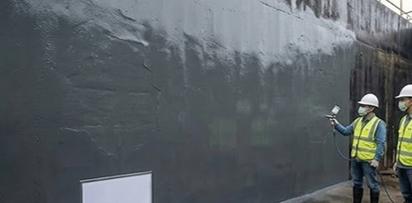
01 On-Site Diagnosis: Identifying Core Issues
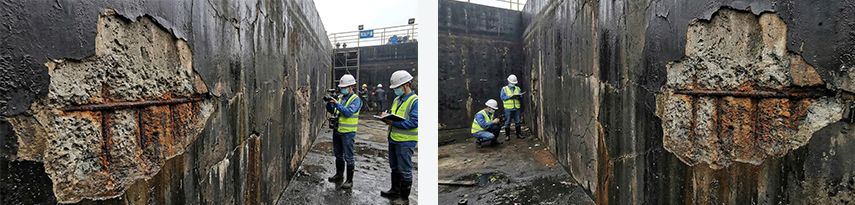
Prior to restoration, the technical team conducted an in-depth survey of the tank structure and identified the following core problems:
Severe Surface Erosion: Due to long-term alternating acid-alkali corrosion and osmotic pressure, the original anti-corrosion coating has largely peeled off. The concrete surface appears "honeycombed" and loose, with reduced strength.
Electrochemical Corrosion of Reinforcement: Chloride ions and acidic media have penetrated to the reinforcement layer, causing severe rusting and expansion of the steel bars, which leads to cracking along the reinforcement within the concrete.
Structural Leakage: Multiple micro-cracks exist in the tank walls, through which acid liquid has been leaking, threatening groundwater safety and corroding the external foundation.
02 Core Technology: Molecular-Level Repair
Addressing the above diagnostic findings, the traditional "chip and patch" approach was abandoned in favor of Water-based Nano Hyperbranched Repair Technology:
Acid-free Rust Conversion Technology: Typical corrosion products are Fe₂O₃, FeOOH, and a certain amount of Fe₃O₄. After film formation, under the action of nanomaterials, FeOOH transforms into more stable crystalline forms like α-FeOOH and β-FeOOH. The nanomaterials also continuously capture escaped, residual, or newly formed rust molecules (Fe₂O₃), converting them into stable FeO·Fe₂O₃ (i.e., Fe₃O₄) and O₂ through nano-exchange separation, significantly extending the protection period.
Water-based Nano Hyperbranched Repair Technology: The water-based nano polymer material reacts and crosslinks with calcium ions in the concrete. Its polymer branched-chain silicates react and combine with Ca²⁺ in the concrete, forming a stable and robust polymer calcium silicate chelate (∼C-S-H). After repair, it can long-term withstand the non-homogeneous deformation, shrinkage, and expansion of the concrete, with a service life of over 20 years.
Multi-scale Anti-permeation Sealing Layer: A nano-level crosslinked network forms on the surface layer, which is not only resistant to strong acids and alkalis but also possesses extremely high resistance to osmotic pressure.
03 Construction Process: Precision Operation
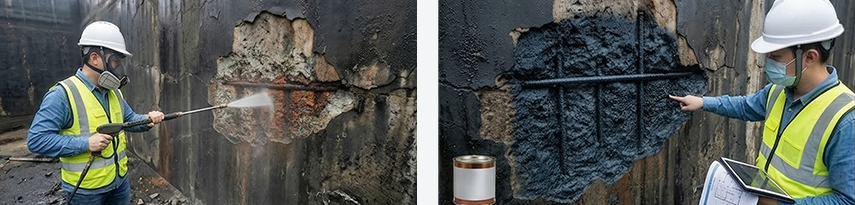
Surface Preparation: High-pressure water jetting (above 2500 bar) is used to remove the loose layer and residual chemical salts, exposing a solid base layer.
Rust Conversion Treatment: A specialized rust converter is sprayed onto exposed reinforcement bars, ensuring that rusted areas are completely transformed into a stable passivation layer.
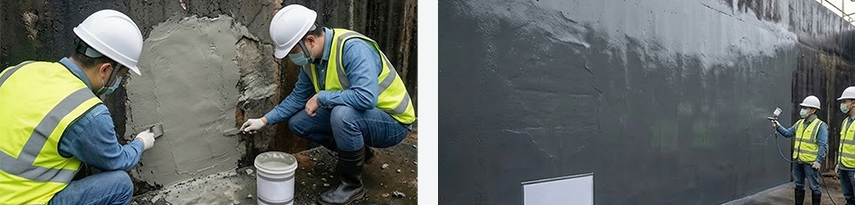
Crack Repair and Leveling: Structural cracks are filled using pressure grouting, and hyperbranched nano-mortar is used for overall leveling of pits to restore the structural dimensions.
Anti-corrosion Topcoat Application: A polymer anti-permeation coating is applied using a "two coats, one cloth" or multi-layer spray process to ensure no pinholes or bubbles.
Curing and Inspection: After construction, spark testing is conducted to ensure the protective layer is continuous and complete.
04 Customer Value: Long-Term Assurance
Extended Service Life: The expected service life of the repaired tank is extended by 15-20 years, significantly reducing the enterprise's recurring maintenance costs.
Environmental Compliance: Thoroughly solves leakage problems, eliminates the risk of environmental fines, and meets national strict audit requirements for hazardous chemical storage.
Construction Cost & Time Efficiency: The acid-free rust conversion process reduces derusting procedures and waste liquid treatment costs, shortening the overall project timeline by 30% compared to traditional methods.
Restored Structural Strength: The concrete's impermeability grade is significantly improved, ensuring the production safety of the chemical facility.