

01 On-site Diagnosis: High-Difficulty Challenges in a Confined Space
Project Background: The first-stage condenser of an associated gas recovery system on an offshore drilling platform suffered severe corrosion due to long-term service in a high salt spray, high humidity environment, with high-velocity seawater as the cooling medium.
Core Damage Points:
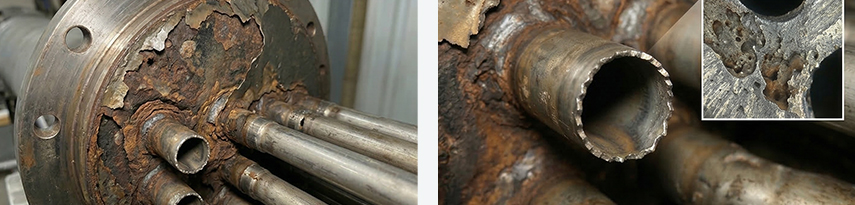
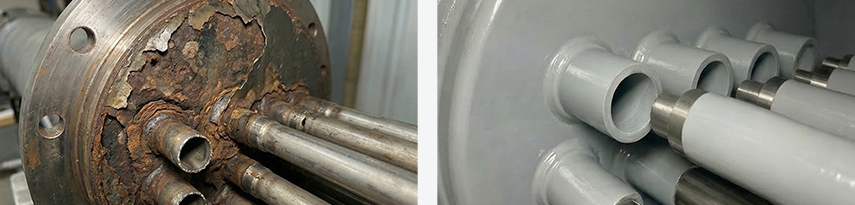
Pitting & Crevice Corrosion: Distinct ulcer-like pitting corrosion appeared at the tube sheet welds.
Physical Thinning (Erosion): Mechanical wear from sand-laden seawater caused significant wall thinning at the ends of the heat exchange tubes.
Galvanic Corrosion: The potential difference between dissimilar metals (e.g., titanium tubes and stainless steel tube sheet) accelerated material loss at the contact interface.
Traditional Coating Failure: The original epoxy coating became brittle and peeled off under high cyclic temperature differences.
Diagnosis Conclusion: The equipment was located in an extremely narrow compartment, making large-scale lifting and replacement impossible. If dismantled and shipped onshore for repair using traditional methods, the daily oil production loss during shutdown would exceed 1 million RMB.
02 Core Technologies: Hyperbranched Nanomaterials & Non-Acid Rust Conversion
Addressing the specific conditions of the offshore platform (prohibition of large-scale blasting, confined space), this repair employed two key cutting-edge technologies:
Non-Acidic Rust Conversion Technology:
Unlike traditional acid pickling, this technology chemically converts residual active rust within micro-pores into stable, passivated chelate compounds. In situations where abrasive blasting is impossible on an offshore platform, this perfectly solves the persistent problem of poor coating adhesion without damaging the metal substrate.
Hyperbranched Nanocomposite Repair Material:
Utilizes a hyperbranched polymer with ultra-high cross-linking density as the film-forming matrix.
Extremely Low Permeability: The nano-scale dense structure effectively blocks the penetration of chloride ions.
Excellent Toughness: Adapts to mechanical vibration and thermal expansion/contraction on the platform without embrittlement.
Strong Chemical Bonding: The repair layer forms a molecular-level bond with the metal substrate, providing extremely high peel resistance.
03 Construction Process: Precision In-situ Reconstruction
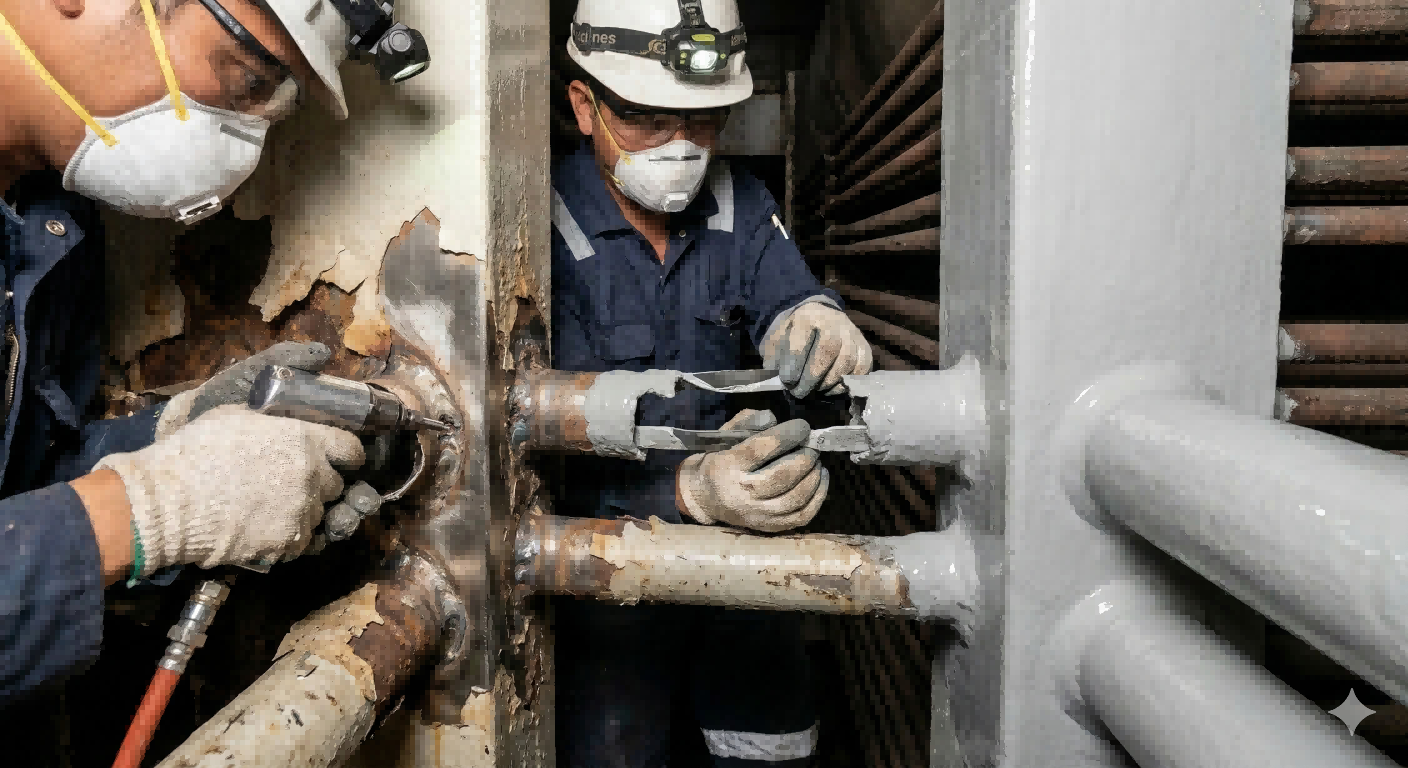
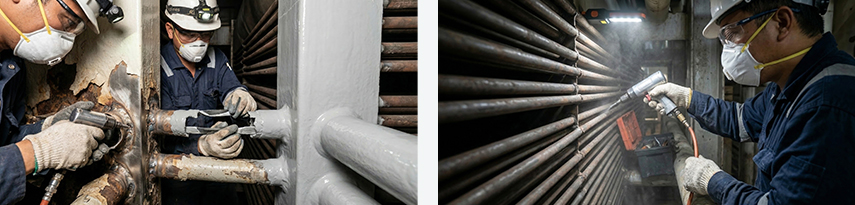
The construction process strictly followed offshore safety regulations and was completed without altering the equipment's physical location:
Surface Cleaning: Power tools were used to clean the substrate to a St3 standard.
Deep Passivation: A non-acidic rust converter was applied to completely transform hidden corrosion in micro-pores, establishing a foundational protective layer.
Tube End Reconstruction (Critical Step): Polymer-ceramic material was used to rebuild the geometric dimensions of thinned tube ends, restoring the design wall thickness and enhancing erosion resistance.
Overall Encapsulation: The tube sheet and internal channel head surfaces were entirely sprayed/brushed with the hyperbranched nano-functional coating, forming a seamless "protective shield" that completely eliminates galvanic interference between dissimilar metals.
Quality Inspection: Dry Film Thickness (DFT) measurements, high-voltage spark testing for pinholes, and surface hardness tests were conducted to ensure a defect-free protective layer.
04 Customer Value: A Double Leap in Efficiency and Lifespan
Rapid Production Restart: The in-situ repair solution reduced the overall project timeline by 70% compared to traditional replacement, saving the client tens of millions of RMB in potential lost output value due to shutdown.
Dramatic Cost Reduction: Total repair investment was only 15%-20% of the cost associated with purchasing new equipment, including logistics and lifting.
Performance Leap: During an inspection after 12 months of operation, the repaired area showed a smooth, intact coating with no new corrosion points. The equipment's service life is projected to be extended by 5-8 years.
Technical Summary: This case demonstrates that in extremely complex offshore conditions, utilizing "advanced materials + in-situ processes" instead of "heavy lifting + traditional replacement" is the optimal path to achieve cost reduction, efficiency enhancement, and practice green repair and refurbishment.