
Case Study: Restoration of a Large-Scale Petrochemical Circulating Water Cooling Tower
1. Project Background and Challenges
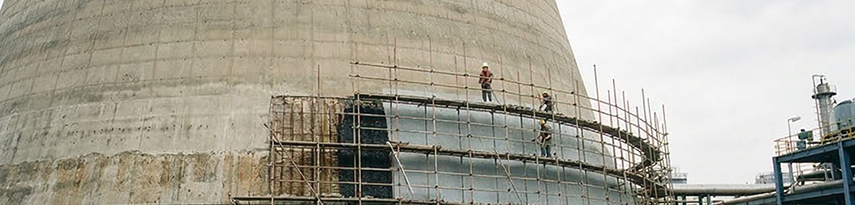
Petrochemical cooling towers operate in harsh environments characterized by high temperature, high humidity, and exposure to acidic gases.
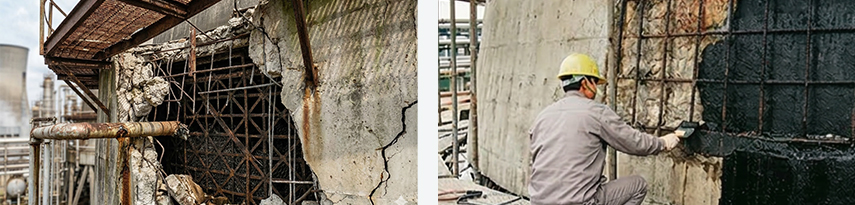
Recurrent Rebar Corrosion: Mechanical derusting cannot eliminate corrosion sources deep within concrete pores. Acid picking poses risks of hydrogen embrittlement and faces strict environmental regulations regarding waste liquid disposal.
Concrete Carbonization: Ordinary mortars or coatings only form a physical bond with the substrate. Under frequent thermal deformation and vibration, interfacial stress leads to hollowing, cracking, and peeling.
Short Protection Cycle: Fine cracks typically appear within 1–2 years, requiring major repairs every 3–5 years. This increases life-cycle costs and causes frequent shutdowns that disrupt long-term plant operation.
2. Core Technologies
Steel-Rebar Interface: For exposed or hidden corroded rebar, traditional acid pickling is replaced by Non-Acid Rust Conversion Technology:
Crystalline Stabilization: Converts loose primary corrosion products FeOOH into chemically stable alpha-FeOOH (goethite) and beta-FeOOH.
Ion Exchange Effect: Continuously captures residual or new rust molecules Fe2O3 and uses nano-scale exchange separation to reverse-transform them into high-density Fe3O4 (magnetite).
Concrete Repair Surface: Utilizes the chemical activity of hyperbranched polymers for deep penetration and cross-linking.
Chemical Chelation: The branched silicate chains of water-based nano-polymers penetrate concrete capillaries and react vigorously withCa2+(calcium ions).
C-S-H Analog Generation: The reaction produces a polymer calcium silicate chelate that forms a microscopic network similar to reinforced Calcium Silicate Hydrate C-S-H.
Durability: This chelate offers excellent flexibility, allowing it to withstand non-homogeneous deformation and thermal expansion/contraction. The design life of this protection exceeds 20 years.
3. Standard Construction Process
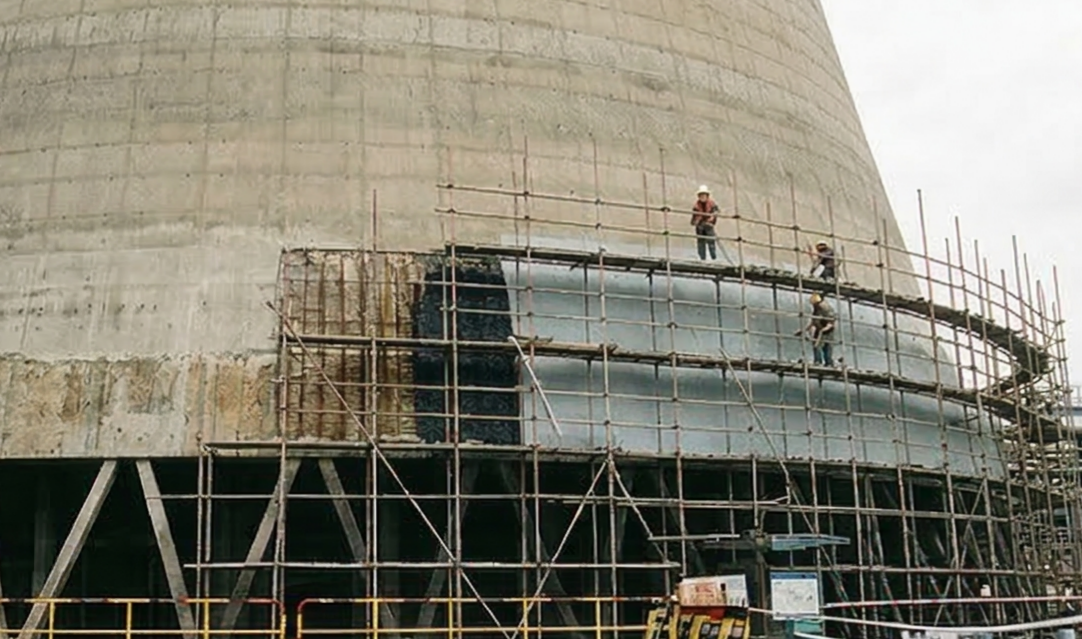
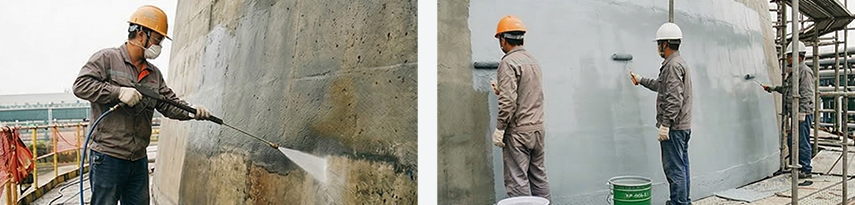
Substrate Preparation: Use high-pressure water jets or mechanical tools to remove loose layers, oil, and laitance from the concrete surface.
Rust Conversion: Apply KB-0651 Water-based Rust-Converting Primer directly to corroded rebar. The red-brown rust will visibly transform into a black, dense protective layer.
Barrier Construction: Apply a system consisting of KB-0652 (Penetrating Sealer), KB-0653 (Anti-carbonization Mastic), KB-0654 (Elastic Polyurethane Mastic), and KP-7535 (Water-based Polyurethane Topcoat). This forms a flexible, "breathable" barrier capable of enduring long-term structural deformation.
4. Customer Value
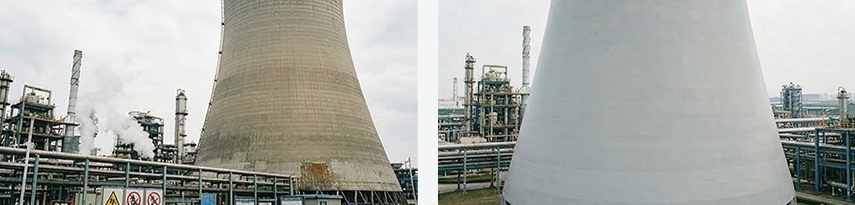
Innovation: Solves the persistent issues of incomplete rust removal and coating delamination.
Longevity: 20+ years of protection significantly reduces long-term maintenance costs for oil & gas enterprises.
Safety: A 100% water-based green system that is non-toxic and complies with strict fire and chemical safety regulations in petrochemical zones.
Resilience: Superior flexibility ensures the structure remains stable despite frequent temperature fluctuations.