



1. On-Site Diagnosis
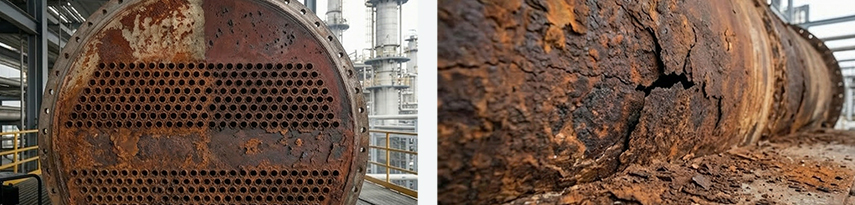
At a petrochemical production facility, the condenser associated with a reactor exhibited classic signs of "heat exchange failure." A detailed inspection by the technical team led to the following conclusions:
Deep Ulcerative Corrosion: The tube sheet surface was covered with uneven, loose reddish-brown rust layers (primarily FeOOH). This structure easily adsorbs chloride ions from the circulating water, leading to honeycomb-like pitting corrosion on the base material.
Crevice Corrosion Hazard: Micron-sized gaps existed at the expanded joints between the tube sheet and tubes. Traditional coatings, due to their large molecular size, cannot penetrate these gaps, creating hidden corrosion cells.
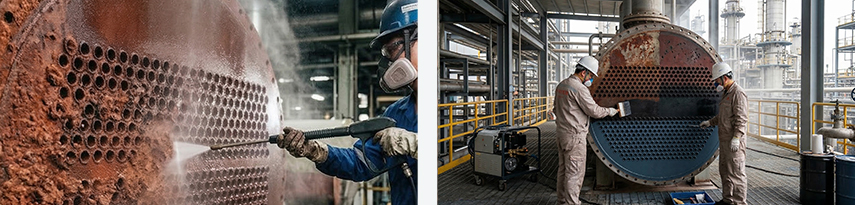
Site Constraints: As the condenser is located in a core production area, sandblasting was prohibited due to dust pollution. The use of strong acids for cleaning was also forbidden to prevent the risk of tube hydrogen embrittlement or damage to sealing gaskets.
2. Core Technology Application
This solution abandoned the traditional "physical removal" approach, instead adopting an advanced path of chemical stabilization and reverse synthesis:
Non-Acid Rust Conversion Technology: Utilizes the superior penetrating power of non-acidic organic complexes to neutralize active corrosion sites. It does not consume the base metal but targets the oxides for chemical, eliminating the hydrogen embrittlement risk associated with acid pickling.
Crystal Stabilization: Through catalysis, the loose and unstable primary products within the rust layer are converted into chemically stable alpha-FeOOH (Goethite) and beta-FeOOH. This crystal transformation alters the physical polarity of the rust, turning it from a "water reservoir" into a "barrier layer."
Nano-Scale Ion Exchange and Fe3O4 Formation: Active nano-components in the coating actively capture residual iron oxide (Fe2O3) molecules and, through ion exchange, reversely reduce them into dense Fe3O4 (Magnetite). This forms a magnetic protective layer on the metal surface that is molecularly anchored to the substrate.
3. Application Process
Phase 1: Primary Cleaning and Surface Activation
The tube sheet is thoroughly flushed using water jetting at 50-70 MPa. The purpose is not to remove all rust, but to precisely eliminate loose surface rust, residual salts, and oil contaminants, exposing the firm, dark red aged rust base for subsequent chemical reactions.
Phase 2: Penetrative Rust Conversion and Crystal
KeBao non-acid rust converter is sprayed or brushed onto the cleaned surface. Utilizing its extremely low surface tension, the agent rapidly penetrates into the tube mouth gaps and microscopic corrosion pits. A visible color change of the surface from reddish-brown to deep black occurs, indicating the nano-ion exchange reaction is underway, transforming the loose rust into a continuous, dense Fe3O4 conversion film.
Phase 3: Hyperbranched Nano-Enhanced Protection
A hyperbranched nano anti-corrosion topcoat is applied over the fully developed conversion layer. This coating features a unique honeycomb cross-linked structure with high molecular density, forming a robust physical barrier that effectively resists long-term high-temperature erosion and particle abrasion from the circulating cooling water.
Phase 4: Detailed Encapsulation of Tube Ends
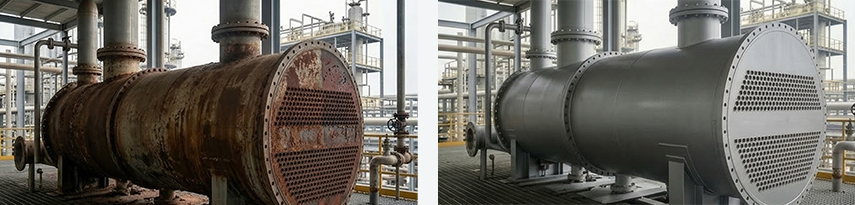
A 360-degree edge encapsulation application is performed on the most vulnerable tube ends. The coating is extended 30-50mm inside the tubes, sealing the annular gap between the tube sheet and tubes, eliminating the potential for crevice corrosion and achieving integrated "shell-type" protection.
4. Customer Value
Enhanced Intrinsic Safety: The acid-free and spark-free process completely avoids the risks of tube perforation and hydrogen embrittlement associated with acid cleaning, ensuring the overall safety of the reactor system.
Multiplied Protection Lifespan: The generated Fe3O4 layer is chemically bonded to the substrate. Its adhesion strength and corrosion resistance are 3-5 times longer than traditional heavy-duty coatings.
Significant Cost Reduction and Efficiency Improvement:
Eliminates Sandblasting: Reduces surface preparation time by approximately 80% and eliminates costs for hazardous waste (acid pickle liquor) disposal.
Reduces Downtime: High application efficiency and fast curing reduce overall repair time by approximately 50% compared to traditional methods.
Sustainable Dynamic Protection: The embedded active ions within the coating maintain long-term chemical activity. Even if subjected to accidental mechanical damage in the future, they can induce local rust conversion, providing a certain degree of "self-healing" capability.