

Project Background
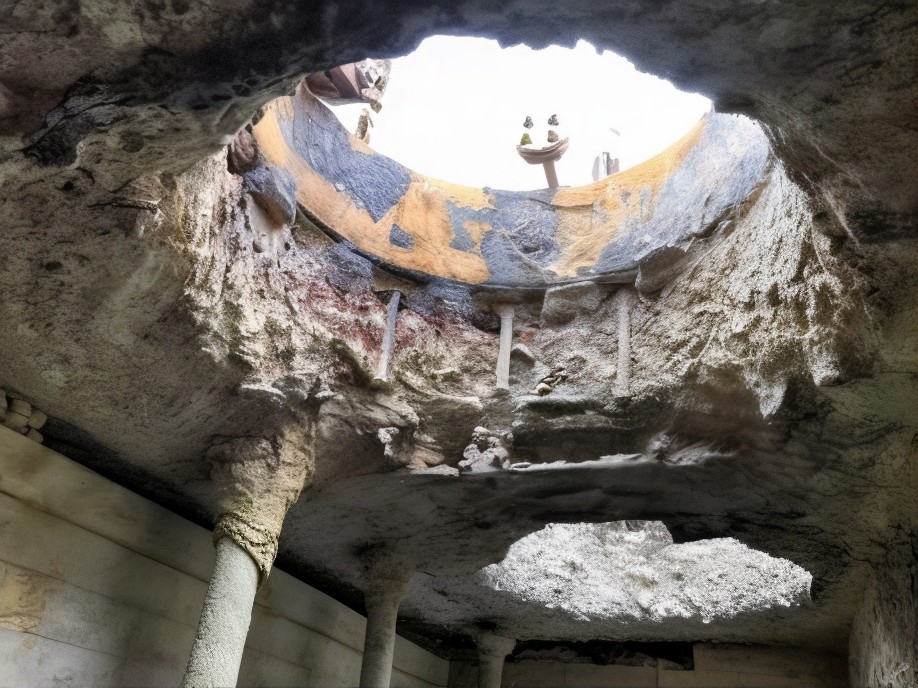
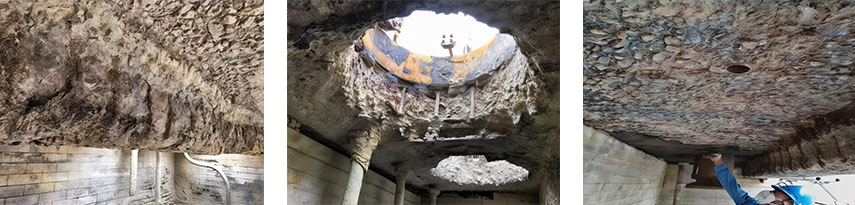
In 2019, a high-temperature sulphur tank operated by the Storage and Transportation Department of Shanghai Petrochemical suffered severe corrosion and damage. With operating temperatures within the tank consistently reaching 135–165°C, the traditional protective coating had peeled off over large areas, putting the tank’s protection system at risk of failure.
To prevent safety incidents and ensure continuous production, the Client initiated an emergency repair project, adopting the Keeper Materials nano-repair material system for the first time.
Project Challenges
Extreme high-temperature environment: Materials must withstand temperatures exceeding 150°C for extended periods without ageing or flaking
Requirement for rapid construction: Shortening the project duration to minimise the risk of production disruption
Strict service life requirements for the repair layer: The Client expected stable operation for at least six months
Construction Plan (5-Step Process)
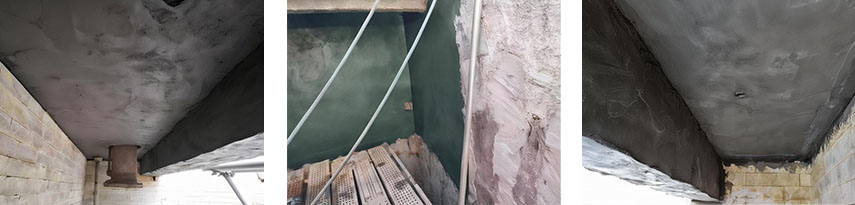
1. Substrate Preparation: Thorough removal of loose cement layers and corroded rust layers
2. Reinforcement Rust Conversion: Treatment of exposed reinforcement using a water-based, non-acidic rust converter
3. Sealing Primer: Application of a nano-penetrating sealing primer to enhance interfacial bond strength
4. Intermediate Repair Coat: Application of a carbonised repair intermediate coat, featuring crack-free thick application and good plasticity
5. Finishing and Topcoat Protection: Levelling with multiple coats of finishing putty + sealing with high-temperature, corrosion-resistant topcoat
Products Used:
KP-308 Rust-Converting Clear Varnish
KP-065-1 Cement Repair Penetrating Sealing Primer,
KP-065-2 Cement Repair Intermediate Coat (two-component),
KP-7530 Water-based Epoxy Primer (two-component),
KP-7535 Water-based Polyurethane Topcoat (two-component)
Technical Highlights
Nano-branched structure materials: Enhances film heat resistance, extending the temperature range to 250°C with long-term stability
Excellent thick-film application performance: Localised repairs up to 4 cm thick without cracking or sagging
Shortened curing cycle: Ready for use 7 days after completion
Actual Performance
Originally planned as an emergency solution with a “six-month service life”
Has actually been in continuous operation for over 6 years, with the paint film intact, no peeling observed, and overall protection fully maintained.
The project has been designated as a flagship case study for high-temperature extreme environments by Keeper Materials
Industry Significance
The successful implementation of this project has not only overcome the engineering bottlenecks associated with traditional organic coatings—namely their poor stability and short service life in high-temperature, highly corrosive environments—but has also, for the first time in China, demonstrated through practical engineering results the adaptability and long-term reliability of water-based nano-branched material systems in extreme petrochemical environments. This marks a crucial leap forward in translating the technology from the laboratory to complex industrial settings.
The project results demonstrate that the coating system provided by Keeper Materials possesses three core advantages: maintenance of structural integrity at high temperatures, long-term corrosion resistance, and stable interfacial adhesion. It has pioneered the establishment of a ‘high-durability, low-maintenance’ concrete full-life-cycle protection technology system in high-risk sectors of China’s petrochemical industry, providing the sector with a solution that can be scaled up and standardised for widespread adoption.
As one of the first projects in China to achieve over six years of maintenance-free, high-temperature corrosion-resistant composite coating engineering, this project not only fills a domestic technological gap but also signifies that China now possesses internationally leading material systems and engineering capabilities in the field of coating protection for extreme environments.
15 October 2019
Wu Mingtao