
Case Study: Integrated Restoration Project for Cooling Towers and Condensing Systems in a Petrochemical Refinery Department
01 On-site Diagnosis: Pain Points & Challenges
An on-site inspection of the cooling towers and supporting condensation facilities in the refinery department revealed the following core issues:
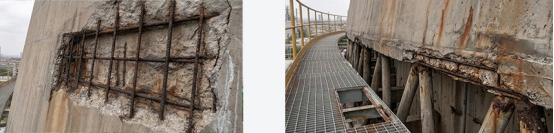
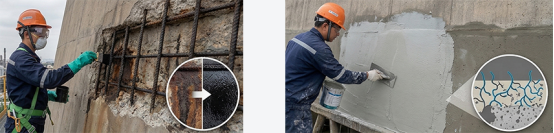
Severe Carbonization of Concrete Structures: Due to long-term exposure to high humidity and cyclic temperature variations, the concrete exhibited large-scale neutralization. This led to reinforcement corrosion and cracking, while traditional repair materials were prone to peeling.
Excessive Corrosion of Metal Components: Fan supports at the tower top, condensing pipe galleries, and walkways/steel ladders suffered from deep oxidation layers caused by acidic mist erosion. Traditional sandblasting was extremely difficult due to fire safety restrictions in the production zone.
Operational Constraints: Restoration had to be carried out without shutting down production. Traditional acid pickling for rust removal produces waste liquid that could easily contaminate the circulating water quality.
02 Core Technology Application
In response to the complex corrosive environment of the refinery’s cooling system, this project abandoned traditional low-efficiency repair methods. Instead, it strategically employed two core proprietary technologies from Keeper Materials to solve structural degradation at the microscopic level.
Technology I: Non-Acidic Rust Conversion Technology
Technical Advantages: This technology breaks through the limitations of traditional strong acid pickling by using neutral chelating components. It penetrates loose rust layers and reacts chemically with iron oxides and hydroxides to form a dense, tough, and chemically stable black organometallic chelate film directly on the metal substrate.
Technology II: Hyperbranched Nano-Concrete Restoration Technology (Structural Matrix Reshaping)
This water-based nano-hyperbranched anti-carbonization technology features a hyperbranched structure that bonds reactively with concrete, forming a stable and robust inorganic grafted polymer chelate.
Post-repair, the structure can withstand long-term heterogeneous deformation, shrinkage, and expansion of the concrete. It offers excellent interlayer adhesion and corrosion resistance, is easy to apply for replacement repairs, and provides high cost-effectiveness.
03 Construction Process & On-site Demonstration
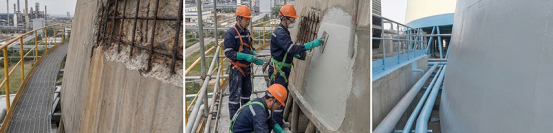
Step 1: Non-Acidic Rust Conversion for Rebars/Components The non-acidic rust conversion primer was applied directly to exposed steel bars and external condensing pipe galleries. The rust layer converted rapidly, forming a dense, integrated anti-corrosion coating that provides excellent adhesion for subsequent painting.
Step 2: Hyperbranched Nano-Material Repair Hyperbranched nano-repair mortar was applied to the damp concrete substrate. The material possesses excellent thixotropy, ensuring no sagging during vertical construction on the tower body and achieving a smooth surface finish.
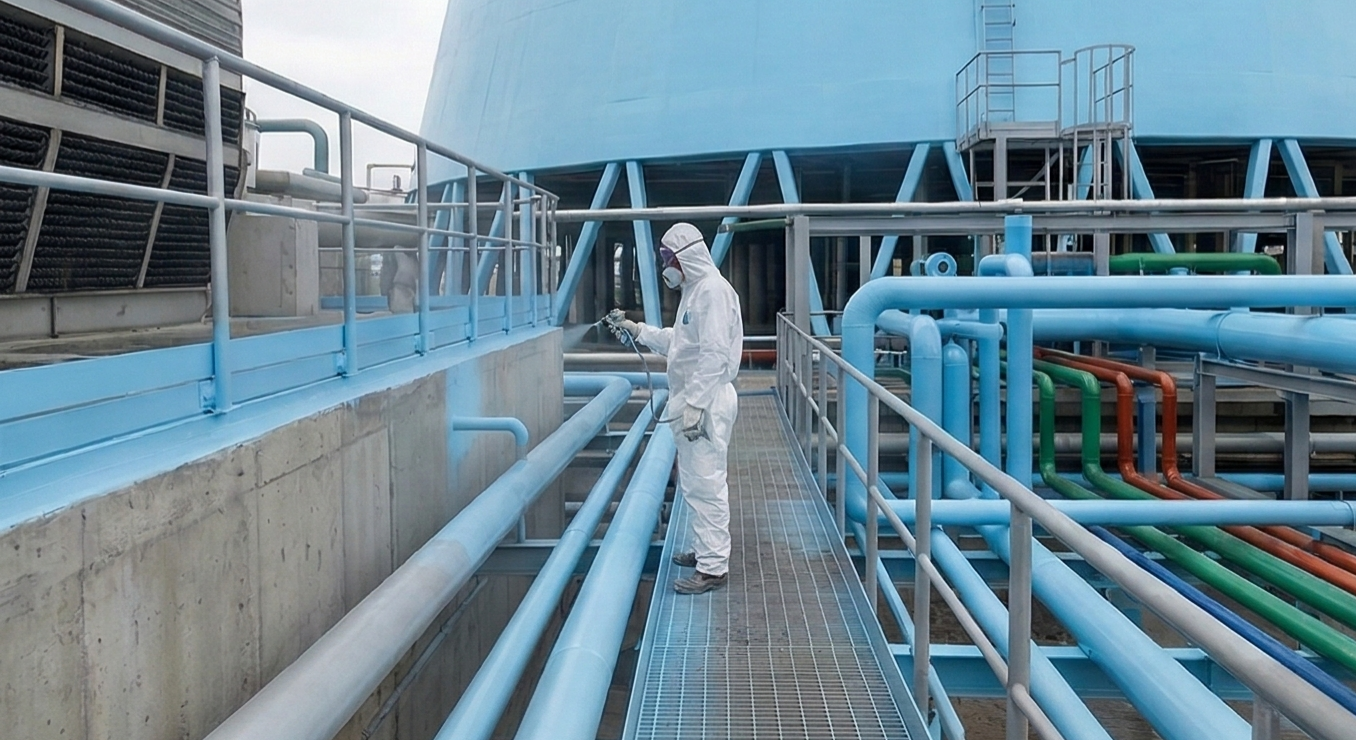
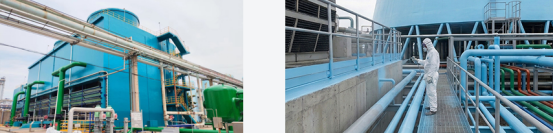
Step 3: Topcoat Spraying & System Restoration Upon completion of the repairs, the entire system was beautified with a high-weather-resistance "Sky Blue" topcoat. Condensing pipelines were color-coded according to standard specifications, resulting in a clean, professional visual effect with clear identification.
04 Customer Value & Long-term Assurance
Enhanced Intrinsic Safety: The use of non-acidic technology eliminated the safety risks associated with "hot work" (grinding/spark-generating rust removal) and strong acid operations, aligning with the stringent HSE requirements of the petrochemical industry.
"Long-Life" Restoration: Hyperbranched nano-technology addresses the common "skin peeling" failure of traditional reinforcements. The maintenance cycle of the restored structure is expected to be significantly extended.
Green & Low-Carbon Emission Reduction: The entire process produced no acidic wastewater discharge, maximizing the protection of water purity within the circulating water system.