

Shanghai World Expo Embankment Protection Project Sets Record: KEEPER MATERIALS New Coating Shows Zero Damage
The anti-corrosion coating project for the Suzhou River and Huangpu River embankments—a landmark infrastructure project of the Shanghai World Expo—has recently completed its 10-year performance monitoring. Monitoring data confirms that:
The surface coating of this embankment, which endures daily tidal fluctuations, high salt fog and a hot, humid environment, has retained its initial performance to this day, setting a new global benchmark for ‘permanent protection’ in aquatic engineering.
The Challenge: A Protection Dilemma Amid Triple Corrosion
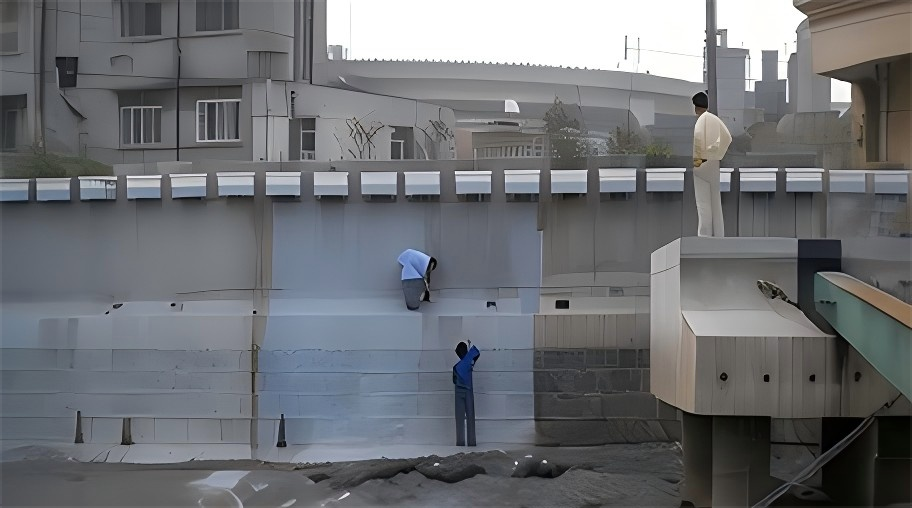
Prior to the 2010 World Expo, the survey team identified two embankments facing severe threats:
Salt Penetration: Seawater intrusion from the Huangpu River accelerated the corrosion of steel reinforcement within the concrete;
Biological Assault: In the high-temperature, high-humidity environment, algae and mould coverage exceeded 60%;
Freeze-Thaw Cycles: Over 20 freeze-thaw cycles annually caused cracks in the substrate to widen.
‘Traditional coatings have an average lifespan of less than five years in such environments,’ the project’s chief engineer admitted at the technical review meeting that year.
The Solution: Fortifying the Dams with Three Layers of Nanotechnology
The KEEPER MATERIALS new materials team developed a targeted composite protection system:
Base Penetration Seal: A specialised sealing primer penetrates 5–8 cm into the concrete, forming a siloxane network within the capillaries to completely block the pathways for water and salt to seep upwards;
Middle Healing Layer: Carbonation repair material containing microcapsules of active substances automatically releases repair factors upon contact with cracks, capable of repairing fissures of up to 0.2 mm annually;
Top Nano Shield: Photocatalytic anti-fouling topcoat utilises TiO₂ particles to decompose organic pollutants, preventing algae spores from adhering and achieving ‘self-cleaning protection’.
Products Used:
KP-308 Rust-Conversion Varnish
KP-065-1 Cement Repair Penetrating Sealing Primer,
KP-065-2 Cement Repair Intermediate Coat (two-component),
KP-7530 Water-based Epoxy Primer (two-component),
KP-7535 Water-based Polyurethane Topcoat (two-component)
Time-tested: From Expo Glory to Urban Landmark
2018 Super Typhoon ‘Yunhu’
The coating in the wave-impact zone showed no peeling, and microbial adhesion was 98% lower than in the unprotected area;
Latest monitoring in 2023
After nearly 13 years of use, the coating retains its full gloss, with a compressive strength retention rate exceeding 98%.
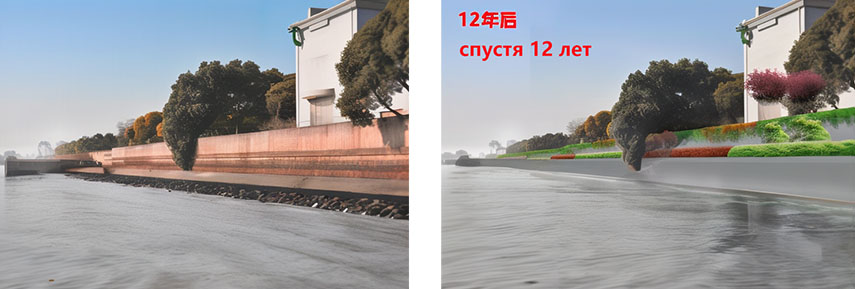
Illustration: Left shows the eroded embankment prior to construction (2010); right shows the protected embankment, as good as new (2023)
Industry Significance: Redefining ‘Permanent Protection’
‘This is not merely a surface coating, but a complete regeneration of the substrate,’ commented an expert from the Institute of Building Materials at Tongji University. This project has demonstrated:
15-year maintenance-free feasibility: significantly reducing life-cycle costs
Versatility in extreme environments: the technology has been transferred to offshore oil platforms in the Bohai Bay
Green revolution: a heavy-metal-free formulation protects aquatic ecosystems
It is reported that this technological system is currently being adopted by several enterprises for project engineering, specifically for the protection and restoration of existing infrastructure. As infrastructure projects enter the era of ‘century-long design’,
this technological legacy from the Shanghai World Expo is being given a new lease of life.
15 August 2019
Wu Mingtao